
Trade and reseller supply
Trade Partners and Resellers: Factory-Direct Modular Supply for Australian Businesses
Factory direct supply for builders, hire fleets and resellers, with repeatable specifications and lead times.
Get a free quoteSupply, not a middleman
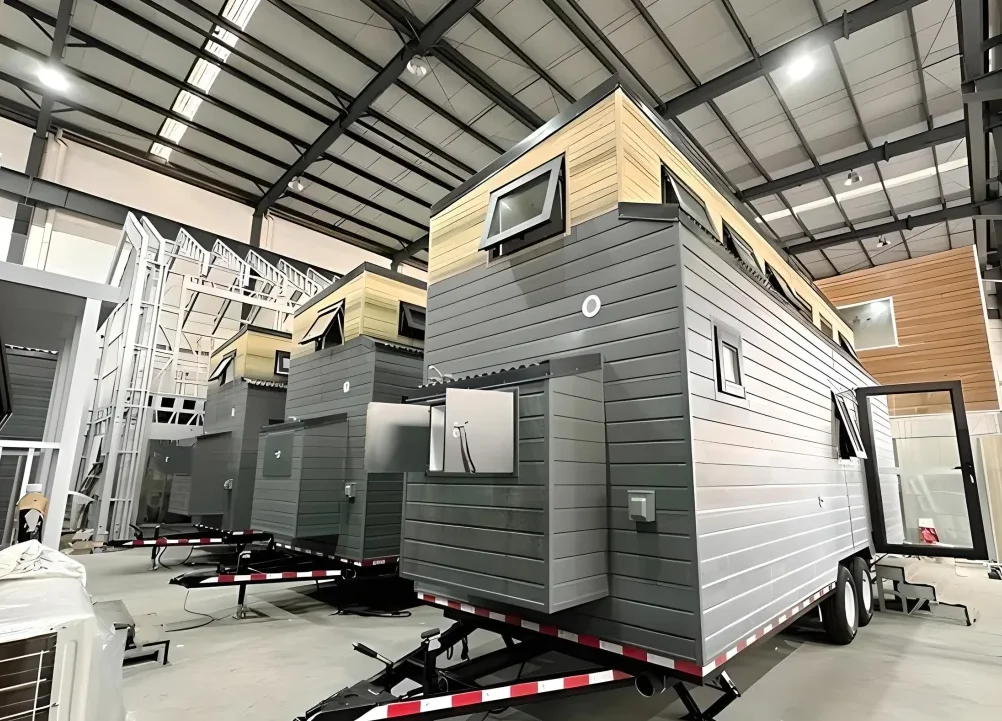
We are the source of supply, not a middleman standing between you and a factory. We buy direct, we commission the Australian engineering, and we assemble the compliance evidence. A trade partner buys that whole chain on one set of terms.
- Factory directWe buy from the factories on our own account, at China factory pricing. No local distributor between you and the line, and no builder margin on top.
- 40-60 daysTypical factory production of 20-30 days and typical delivery of 20-30 days, order to site.
- Australian engineeringStructural design certified by an Australian registered engineer for your site’s wind and soil classification.
- One relationshipHomes, hire fleet product and containers from one supplier, on one set of terms, through one compliance process.
Apply as a trade partner See the full range
Who this is for
This page is for businesses that buy buildings to resell, to hire out, or to place on their own projects.
- Builders and developersRepeat units for subdivisions, infill sites and staged projects, supplied to your program rather than negotiated one home at a time.
- Tiny home and granny flat retailersProduct to sell from your own yard or website, with the drawings, floor plans, specifications and photography to sell it with.
- Portable building hire companiesFleet purchases of site offices, ablution blocks and portaloos, built to a locked specification so the tenth unit matches the first.
- Caravan, RV and camping retailersTiny homes on wheels for yards already set up to sell, tow and service road-registered product.
- Landscapers, pool builders and outdoor living businessesStudios, pods and garden rooms added to jobs you are already quoting, without taking on a second trade.
- Remote and mining accommodation suppliersAccommodation and ablution modules in volume, delivered to remote receiving points rather than to a metro yard.
- Regional dealersA territory, a display unit and a supply line, for operators who want to be the name for modular in their own patch.
Buying one home for yourself? This page is not the right starting point. The full range of modular and portable buildings is a better place to begin, and a quote there does not need an ABN.
What you get as a trade partner
- Factory-direct supplyWe buy from the factories on our own account, at China factory pricing. There is no local distributor sitting between you and the line that builds your unit, and no builder margin stacked on top of it.
- ISO 9001 certified factoriesISO 9001 is a factory quality management standard. It describes how a factory controls its own process, which matters when you are buying from overseas. It is not evidence that a building meets the National Construction Code, and we never present it as though it were.
- The Australian compliance work, done before you sellStructural design certified by an Australian registered engineer for your site’s wind and soil classification. We supply the compliance documentation to your building certifier or surveyor, who issues the approval.
- Independent pre-shipment testing and inspectionArranged and paid for by us, at the factory, before the unit is loaded. A problem found on the factory floor is a production issue. The same problem found on your customer’s slab is your problem, and that is the difference we are buying.
- A controlled specification per modelHeld by us, not by the factory, so repeat units are built to the same document rather than to whatever the line ran last month.
- Australia-wide logistics coordinationSea freight, customs clearance and the road leg to your agreed receiving point. Crane, set and services connection sit on your side of the line.
- A programme you can quote a customer fromTypical factory production of 20-30 days and typical delivery of 20-30 days, around 40-60 days in total from order to site.
- Breadth on one relationshipHomes, hire fleet product and containers from one supplier, on one set of terms, through one compliance process.

One supplier across the range
Everything we list is an example of what we build. It is not a stock list, and nothing sits in a yard waiting for a buyer. Every unit is built to order.
Hire fleet product
For hire companies buying a fleet, not a unit
Site offices, ablution blocks and portable toilets from one supplier, on one set of terms, with one compliance process behind them. Add modified shipping containers and you have most of a hire fleet covered by a single relationship.

Hire fleet
Site offices
Container shells and panelised cabins, built to a locked specification so the units stack, transport and hire out as one class.
Trade terms on application
Hire fleet
Ablution blocks
Shower and toilet blocks for camps, events and remote sites, ordered in fleet quantities to one build document.
Trade terms on application

Hire fleet
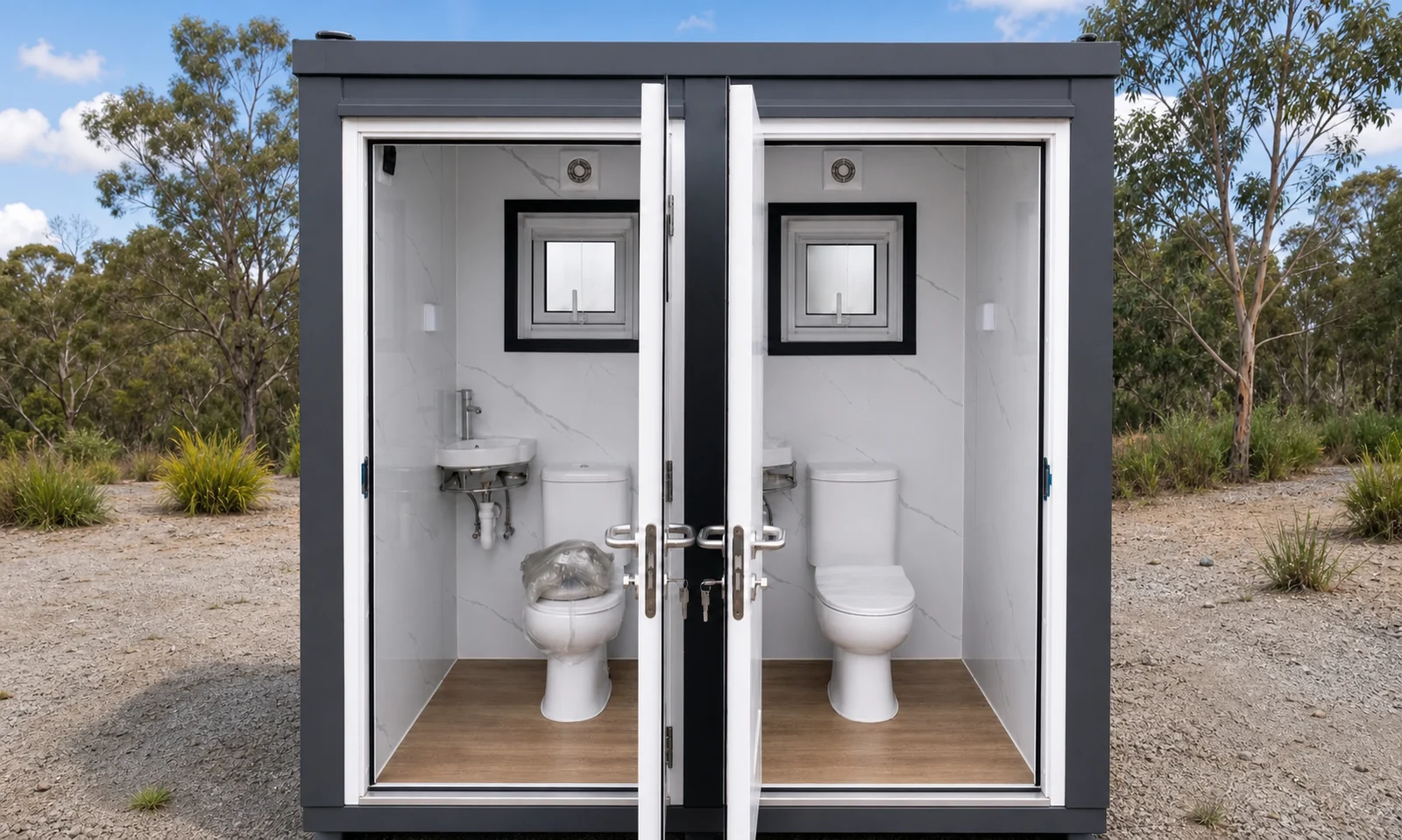
Portable toilets
Single cabins, twin blocks and accessible units, with lifting lugs and forklift pockets in the same places on every unit.
Trade terms on application

Hire fleet
Modified shipping containers
Real container shells cut, lined and fitted out in the factory, then delivered ready to put on hire.
Trade terms on application
Dwellings and accommodation
For retailers and builders selling somewhere to live
The same arrangement applies on the dwelling side. Dwellings are built to order to NCC Class 1a requirements, compliance documentation supplied.

Dwellings
Granny flats and ADUs
A second dwelling for the back yard, supplied with the compliance documentation your customer’s certifier reads.
Trade terms on application

Dwellings
Expandable homes
Folded to container width for the road, opened out on site. The freight efficient end of the range for a partner ordering in volume.
Trade terms on application
Dwellings
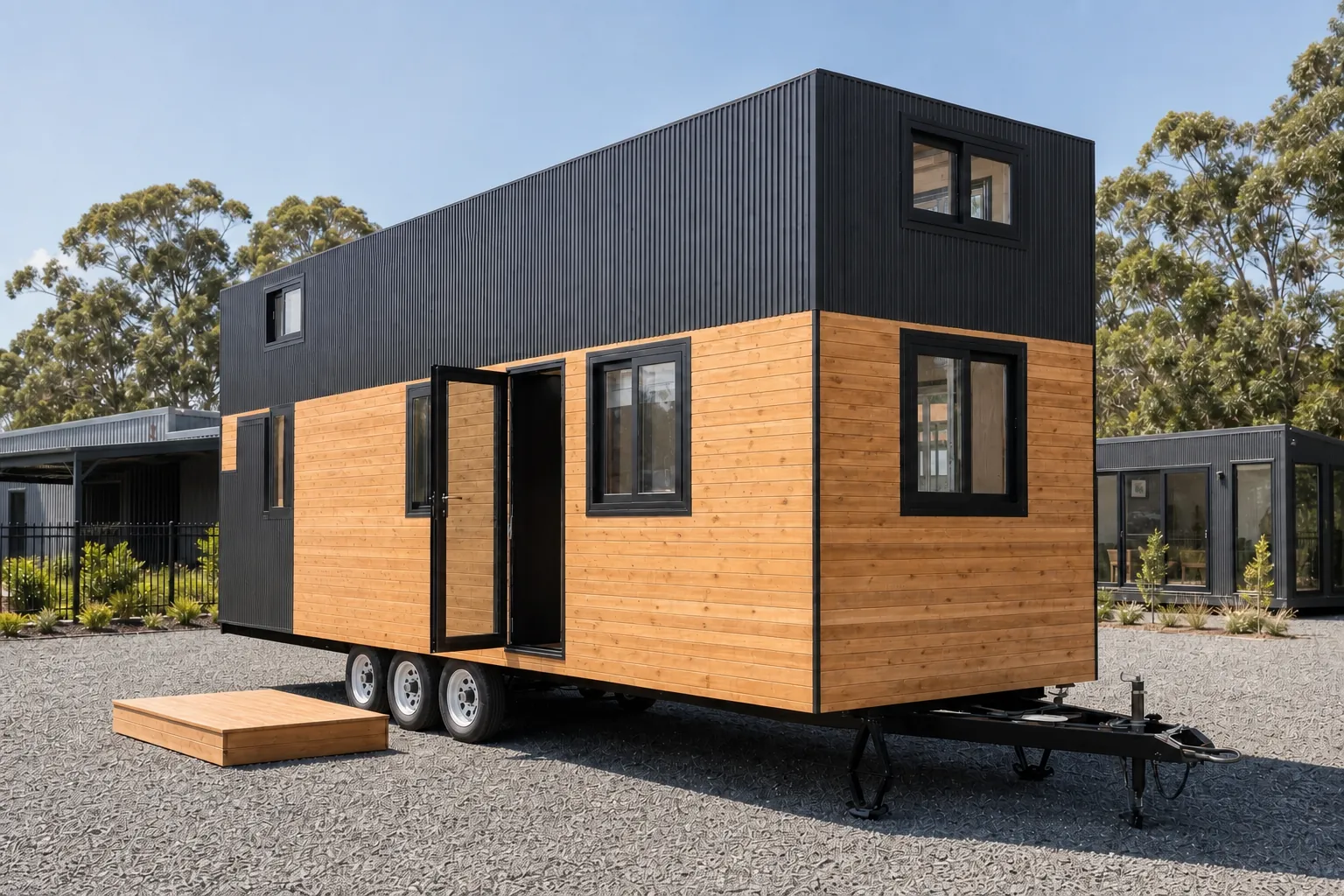
Tiny homes on wheels
Road-registered product for caravan, RV and camping yards already set up to sell, tow and service it.
Trade terms on application
Dwellings
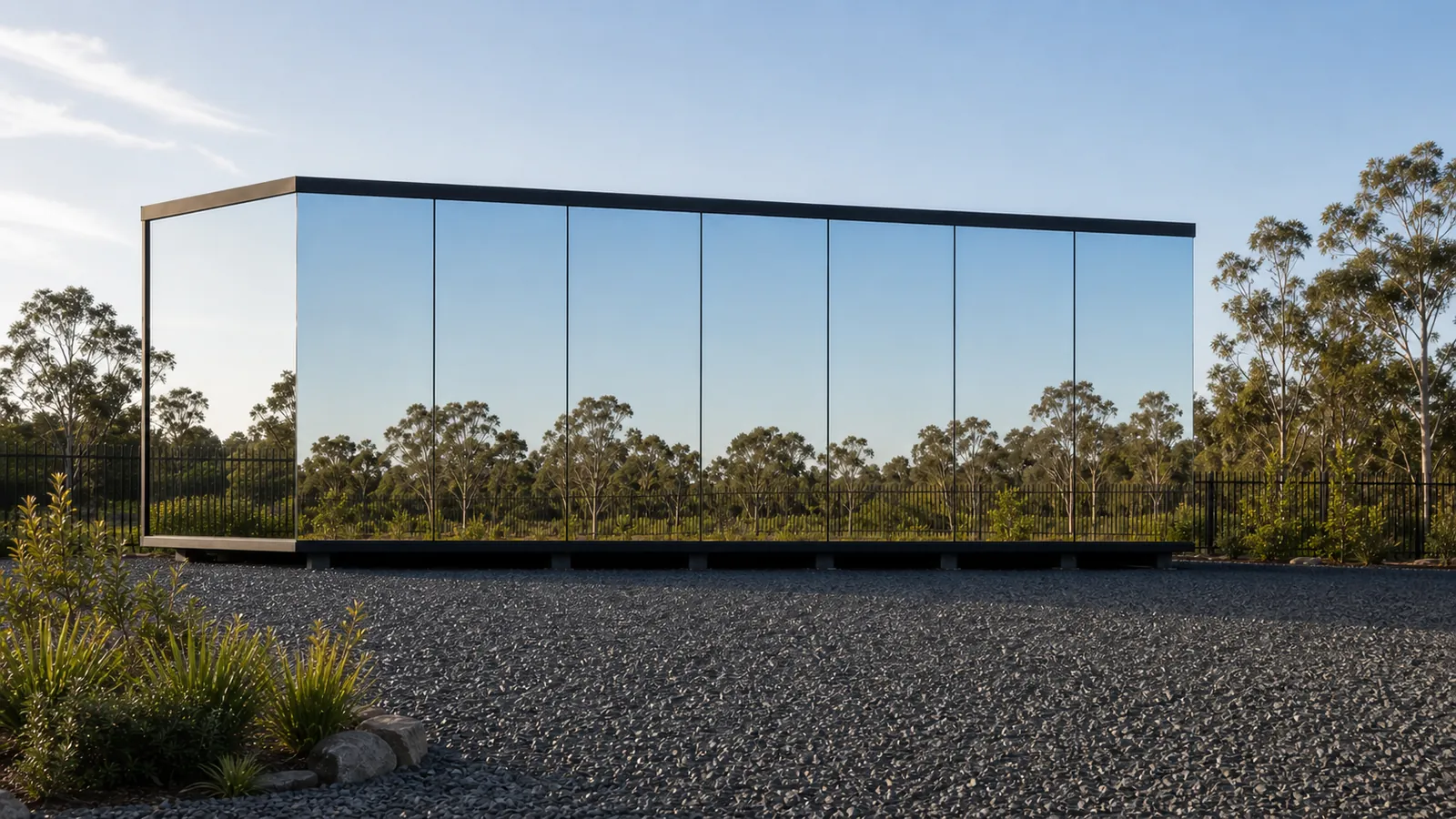
Mirror houses
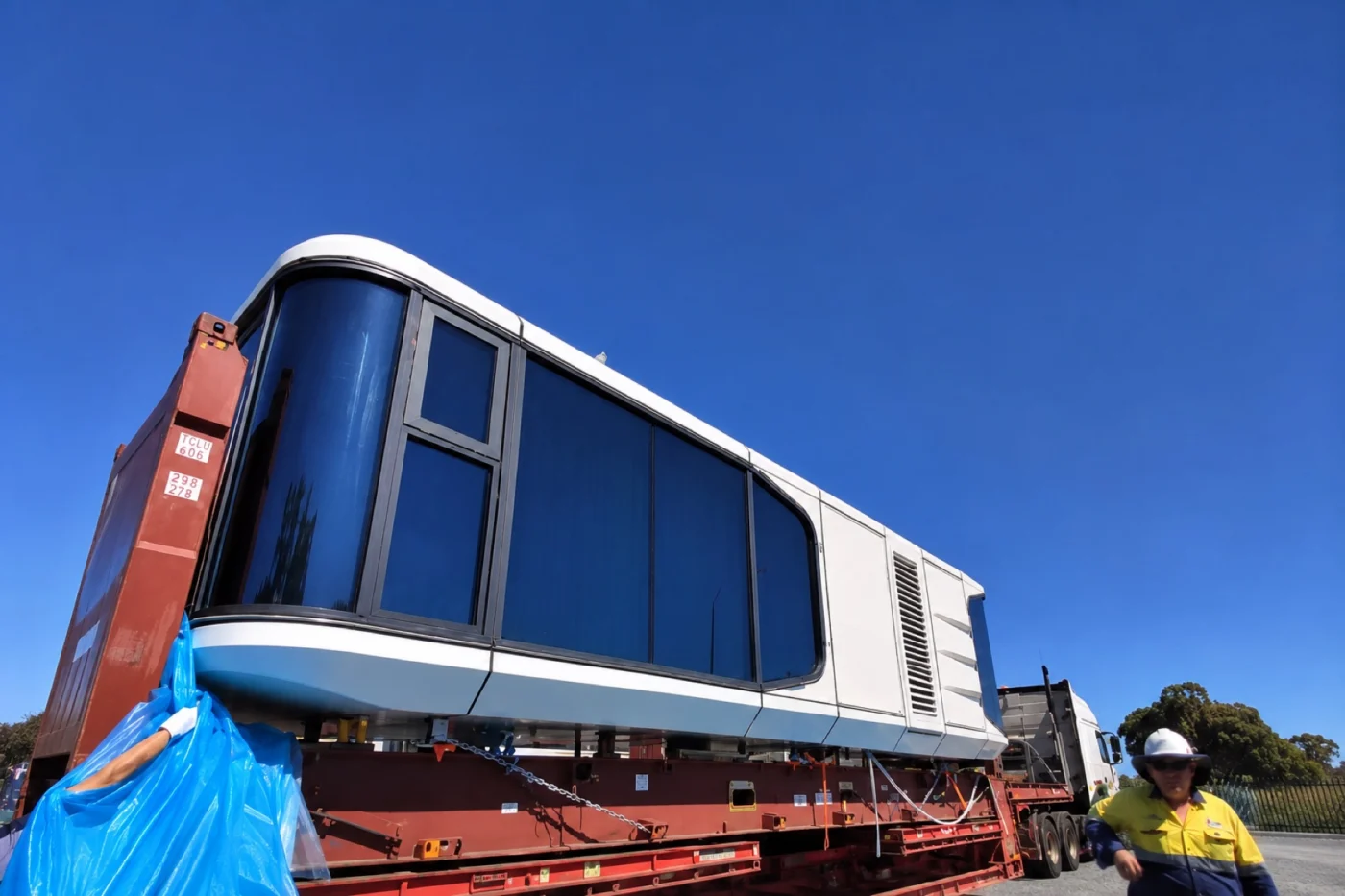
Cabins skinned in one way reflective glass, for operators who want something the local market does not already stock.
Trade terms on application
Modular homes, bathroom pods and modular garages sit in the same range and are supplied on the same terms.
See every model we build Build to your own drawings
The compliance work we do for you
This is where imported supply usually fails a trade partner, and it is the part we do before anything ships.
Structural design certified by an Australian registered engineer for your site’s wind and soil classification. We supply the compliance documentation to your building certifier or surveyor, who issues the approval.
Dwellings are built to order to NCC Class 1a requirements, compliance documentation supplied. The pack is assembled per project, because it has to be: an engineer certifies against the wind region, terrain category and soil classification of a real address, not against a generic overseas load case. In plain terms the pack covers the structural engineering certification, computation reports referencing the Australian Standards they were worked to, material and weld documentation, footing design inputs, test reports naming the laboratory, and the as-built dimensions, weights and lift points your crane crew needs.
We are not a certifier and we are not a building surveyor. Those are protected roles held by registered professionals in your state, and we do not hold them. We produce evidence. Your certifier decides whether that evidence satisfies the National Construction Code on that site, and the decision is theirs, at their discretion, and dependent on the council and the block.
Anyone telling you an imported building already has its approval, or that the approval is a formality, is either confused or hoping that you are. If your salespeople repeat it, it is your business that wears the consumer law problem first.
Who does what
The single most useful thing we can publish is the line between us. Everything in the right hand column is yours, and it is yours whether or not we write it down, so we would rather write it down.
| We supply | You are responsible for |
|---|---|
| Factory production to the agreed specification, and the factory quality control that goes with it | The site itself: survey, soil classification, and the planning decision on the block |
| Independent pre-shipment testing and inspection, before the unit is loaded | Civils, footings and slab, built to the engineering we supply |
| Structural design certification by an Australian registered engineer for the wind region and site classification | Engaging the building certifier or surveyor and lodging the application |
| The compliance documentation pack, issued to your certifier in a form they can act on | Crane, set and levelling on the day, and traffic management if the street needs it |
| Sea freight, customs clearance and the road leg to the agreed receiving point | Connection of services: power, water, waste water and stormwater |
| Spare parts and the defect path, on the terms written into your supply agreement | Final fit-off by your licensed electrician and plumber, and the certificates they sign |
| Drawings, floor plans, specifications and photography for the models you supply | Your customer: quoting, contracting, install, handover and the relationship afterwards |
How delivery and installation works
Programme and lead times
A partner who has promised a customer a date needs stages, not one headline number. These are the stages, and they are the same ones we quote a retail buyer, because inventing a shorter number for the trade would only move the problem to the person standing in front of your customer.
- Quote and specificationWe come back with a written quote against a specification, not a brochure line.
- Deposit and production slotThe slot is booked when the order is confirmed. This is where a rolling forecast earns its keep, because a slot held ahead of time is a slot you are not queueing for.
- Factory productionTypically 20-30 days.
- Pre-shipment inspection and documentationInspection at the factory, then the compliance pack assembled while the unit is in transit rather than after it lands.
- Freight and deliveryTypically 20-30 days. Sea leg, customs, then road to the receiving point.
- Order to siteAround 40-60 days in total.
If a stage slips, you hear about it when we hear about it, not when the container fails to arrive. That is the whole commitment. Not that nothing ever runs late, because in international freight that is not a promise anyone can keep, but that you are never the last to know.
How it works, from first enquiry to first order
- Tell us about your businessABN, what you sell now, the categories you want to supply and roughly what volume you are thinking about. Ten minutes of writing saves two weeks of circling.
- We come back with trade termsTerms are on application and are set against your categories, your volume and your region. There is no published trade sheet, for you or for anyone else.
- We agree the ground rules in writingTerritory, lead handling, brand, stock and display, freight and the receiving point, payment structure, warranty and the defect path. All of it before the first order, not after the first argument.
- We lock the specificationFor each model you will supply, we fix the build specification document and hold it. That document is what the factory builds to on every subsequent order.
- First orderDeposit, production slot, and the site details for each unit that needs site-specific engineering certification.
- Production, inspection and documentationBuilt, inspected before loading, and the compliance pack assembled for your certifier.
- Delivery, then reviewAfter the first units land we go through what actually happened against what we said would happen, and set the forecast for the next run.
Start a trade enquiry Book a call
What we need from you
We ask serious questions because we would rather find out now that we are not a fit than find out on your third order. Have this ready:
- Your ABN, trading name and how long the business has been operating.
- What you sell or hire today, and to whom. A hire company, a retailer and a builder each need a different arrangement.
- The product categories you want to supply, from the range above.
- Indicative annual unit volume. A range is fine, and an honest range is worth more than an optimistic number.
- The states and regions you cover, and whether you want a territory discussed.
- Builder’s licence details, if you hold one and if your state requires it for what you intend to sell.
- Whether you want a display unit, and where it would sit.
- Your timeframe, and whether you have a live job or customer waiting.
We do not publish a minimum. Volume is one of the things we work out with you, case by case, alongside the categories and the region. What we will not do is pretend a one-unit-a-year arrangement and a fleet arrangement are the same conversation.
How a trade order differs from a one-off order
| Buying one unit | Supplying as a trade partner | |
|---|---|---|
| Specification | Chosen per project from the models we build | Locked per model, held by us, and changed only with our written sign-off |
| Lead time | Around 40-60 days from order to site | The same the first time. Repeat orders run against a production slot booked ahead on your forecast |
| Engineering | Certified for that one address | The model design work carries across, so what repeats per order is the site-specific certification for each new address |
| Documentation | Pack issued to your certifier | Same pack, plus your sales staff briefed on what it does and does not say |
| Brand | Ours | Agreed in writing before the first order |
| Sales material | What is on this website | Drawings, floor plans, specifications and photography for the models you supply |
| Terms | Deposit and balance, factory quote available | On application, set against your categories, volume and region |
Consistency between units
Every importer who has been burned has been burned the same way. The first container is excellent, the fourth has a different door handle, a thinner profile and a fitting nobody signed off, and by then it is sitting in your yard with your name on it.
- The specification document is ours, not the factory’sWe hold a controlled build specification per model. Repeat units are built to that document.
- No substitution without written approvalA factory cannot swap a material, a fitting or a profile because a supplier ran short or a price moved. It goes back through us first.
- You are told before it reaches your orderWhere a change is approved, partners supplying that model are notified before it affects units already forecast, not left to discover it at unpack.
- Inspection catches the restIndependent pre-shipment inspection at the factory is the check that a locked specification is worth anything, because a specification nobody verifies is a wish.
Warranty, defects and spares
Nobody can prove in advance how they will behave on the first defect, which is exactly why the process belongs in public.
- Who your customer claims againstWhoever they contracted with. If they bought from you, you are their supplier under Australian Consumer Law. Behind you sits us: an importer is treated as the manufacturer of the goods it brings in when the overseas maker has no place of business in Australia, and the factories we buy from have none. That responsibility does not move, and we are not looking for a way to move it.
- Transit damage is a different animal to a later faultDamage is raised at delivery, photographed and written on the docket before the truck leaves, because that is what makes it a freight and insurance matter. A fault that appears later goes down the defect path instead.
- How a claim is raisedIn writing, with the model, the order reference and photographs. It goes to us, not to the factory, and we run it from there.
- SparesParts are ordered against the model’s controlled specification, which is the practical reason we hold that document. A fitting we can name is a fitting we can replace.
- The written termsWarranty duration, response and remedies for your arrangement are set out in your supply agreement rather than on this page, because they depend on the product and on how you are selling it. Ask for them in writing before the first order, from us and from anyone else you are comparing.
Marketing, brand and images
Partners supplying our models get the drawings, floor plans, specifications and photography for those models to use in their own advertising. Whether you sell under your own brand or ours, and whether our name appears to your end customer, is agreed in writing before the first order rather than assumed by either side.
There is one condition, and it is not negotiable. Do not repeat claims we do not make. Nothing we supply arrives with an approval already granted, and no building can be described as satisfying the National Construction Code before a certifier has assessed it on the site it is going to.
The wording is that it is built to order to NCC Class 1a requirements, compliance documentation supplied, and that the certifier issues the approval. We will brief your sales staff on that story, and we will tell you plainly which phrases create a problem before they go into print, because a salesperson who overstates the compliance position creates a consumer law problem for your business first and ours second.
Commercial terms
Trade terms are on application. We do not publish prices on this website for anyone, trade or retail, and we are not going to publish a margin or a minimum order either. What we will do is answer every one of these in writing before you commit:
- Deposit and balance structure, and what triggers each stage.
- Freight: which Incoterms apply, and where the agreed receiving point is.
- The point at which title and risk pass to you.
- Insurance in transit, and who holds it on each leg.
- GST and import duty, and how they appear on your invoice.
- Territory and lead handling, as a clause rather than a general assurance.
- Warranty, defect handling and spares.
- What happens to your production slots if a forecast changes.
Questions trade buyers ask
Will you sell direct to a customer in my area?
We sell to retail buyers through this website, and we are not going to pretend otherwise on a page aimed at people who can check. What we will do is agree in writing, before your first order, how enquiries from your region are handled and whether your territory is exclusive for the categories you supply. Ask us to put it in the agreement. A supplier who answers this question with a general assurance instead of a clause is answering a different question.
Who does the end customer contract with, and whose warranty is it?
Your customer contracts with you, and you are their supplier under Australian Consumer Law. Behind that, we are the importer of the goods, and under the ACL an importer is treated as the manufacturer when the overseas maker has no place of business in Australia. The factories we buy from have none, so that responsibility sits with us and stays there. The duration, response and remedies that apply between you and us are written into your supply agreement.
A unit arrives with a damaged panel. Who fixes it and who pays?
It depends on when it happened, which is why the delivery inspection matters more than anything else in this answer. Damage in transit is documented at delivery, photographed and noted on the docket before the truck leaves, and it is then a freight and insurance matter that we run. A fault that shows up later is a defect, raised in writing with the model, the order reference and photographs, and it comes to us rather than to the factory. In either case you are not the one negotiating with an overseas plant in a different time zone.
How long do repeat orders take once I am set up?
The build itself does not get faster, because it is still built to order: typically 20-30 days in the factory and 20-30 days in transit, around 40-60 days from order to site. What changes is the queue. An established partner on a rolling forecast books production slots ahead, so the order goes into a slot that is already held rather than joining the back of the line. The specification stage also disappears on repeats, because the specification is already locked.
How do I know the tenth unit is the same as the first?
Because the specification document is held by us rather than by the factory, and the factory cannot substitute a material, a fitting or a profile without our written approval. Where a change is approved, partners supplying that model are told before it reaches units already forecast. Independent pre-shipment inspection at the factory is what verifies the unit actually matches the document, and it happens before loading rather than after landing. This is the failure mode that costs importers the most and it is the one we design against hardest.
Who pays freight, and when does risk pass to me?
Both are written into each order rather than assumed. We coordinate the sea leg, customs clearance and the road leg to an agreed receiving point, and the order names the Incoterms, that receiving point, the point at which title and risk pass to you, and who holds insurance on each leg. If a supplier will not name the Incoterms in writing, that is the answer.
Will my certifier accept the documentation, and when do I get it?
Acceptance is at the certifier’s discretion and depends on the site and the council, and no supplier can promise you an outcome there. What we control is the quality and the timing of the evidence. The structural design is certified by an Australian registered engineer against the wind region, terrain category and soil classification for that address, the pack is assembled in the order a certifier reads it, and it is issued so it is with you around delivery rather than chased afterwards. Late paperwork is what strands a building on site, so if a certifier wants more, we go back to the engineer or the laboratory and get it. That is our job, not yours.
Is there a minimum order to become a trade partner?
We do not publish one. Volume is worked out with you, case by case, alongside the categories you want to supply and the region you cover. What we will not do is pretend a one-unit-a-year arrangement and a fleet arrangement are the same conversation, so tell us honestly what you expect to move and we will tell you honestly whether we are a fit.
Apply to supply
Send us the business, not just the enquiry. Include your ABN and trading name, what you sell or hire today, the categories you want to supply, indicative annual volume, the states you cover, whether you want a display unit, and your timeframe. Put “trade partner” in the message so it lands in the right queue.
We come back with trade terms on application, the specification and programme for the models you are interested in, and a written answer on territory, freight, warranty and the defect path before you commit to anything. If we are not the right supplier for what you are doing, we would rather say so at the first email.
Apply as a trade partner
Tell us your ABN, your categories and roughly what volume you are thinking about. We come back with trade terms on application.