
Site offices
Site Offices Australia
Container shells and panelised cabins, built to order and delivered wired, insulated and air conditioned.
Get a free quoteFour site offices, delivered Australia wide and craned or forklifted straight off the truck. Three are real shipping container shells in 10ft, 20ft and 40ft. The fourth is a panelised cabin with full height corner glass, for the days when someone who is not a tradesman walks through the door. All four are built to order and all four arrive finished, wired and air conditioned. Below them sit two folding site containers, which are the opposite proposition: bare insulated shells that fold flat for freight and stand up on the pad in about an hour without a crane.
Site offices we build
Four models, built to order in the factory and delivered anywhere in Australia. Three container shells and one panelised cabin. Choose by how many people have to sit in it and by who walks through the door. Dimensions, inclusions and photographs sit on each model page. Price on request on all four.
Site Offices Australia
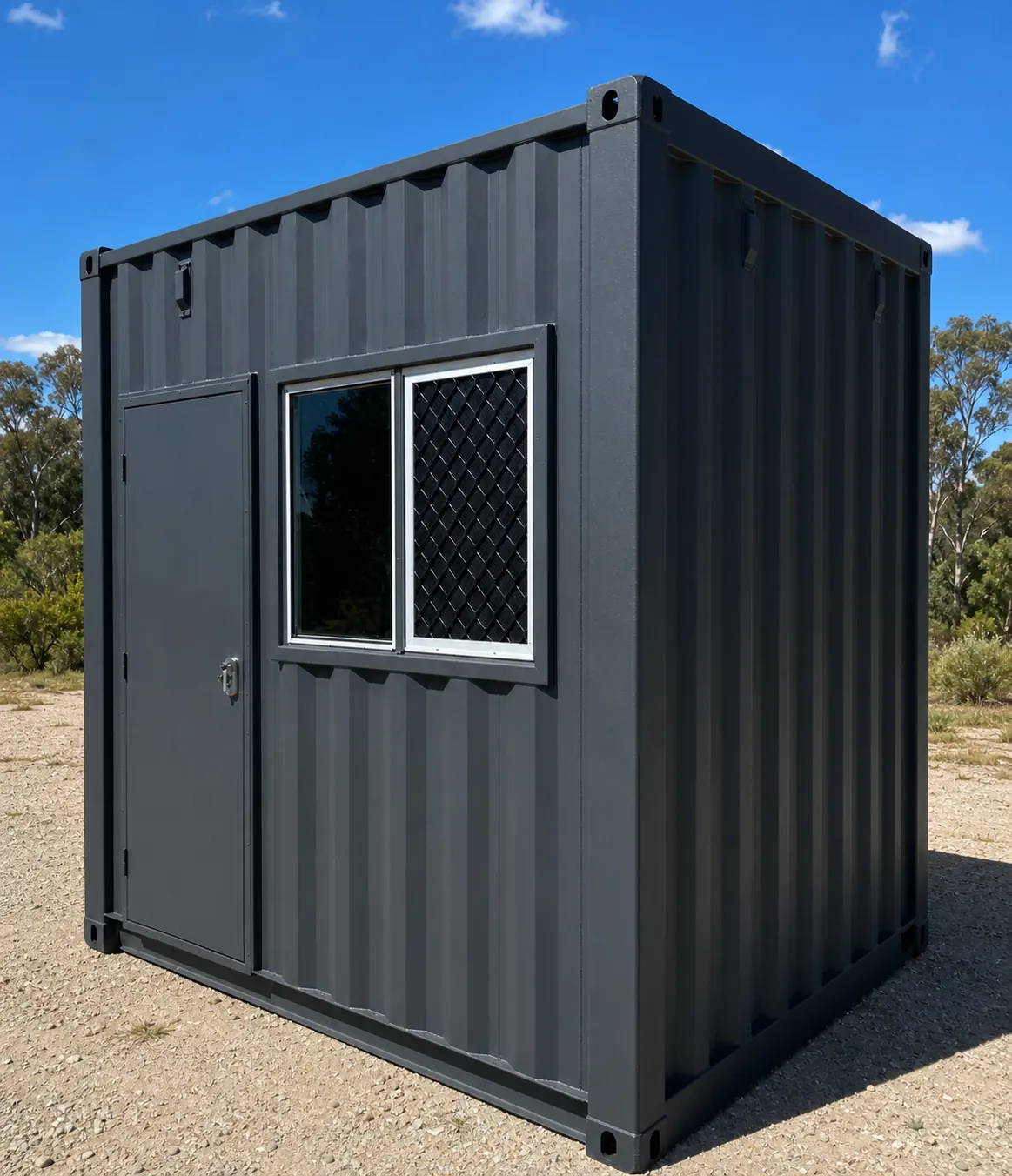
SO10 Container Site Office 10ft
One desk and a print bench. The size you buy when the office is really a post: a gate, a weighbridge, a first aid room.
4 photos
Factory quote available
Site Offices Australia
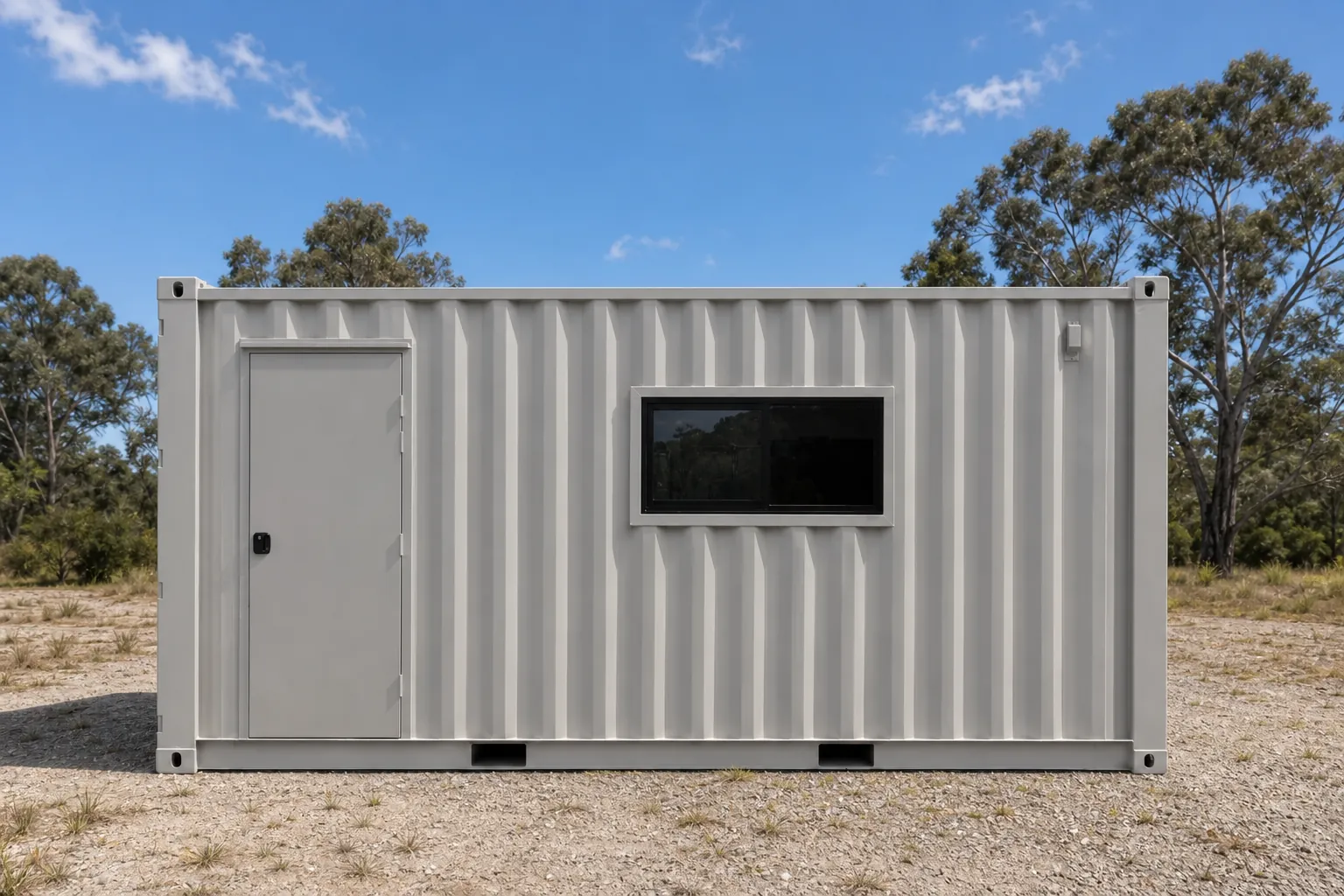
SO20 Container Site Office 20ft
The default pick. Two to four people, filing down one wall, and room for a chair on the visitor side of the desk.
4 photos
Factory quote available
Site Offices Australia
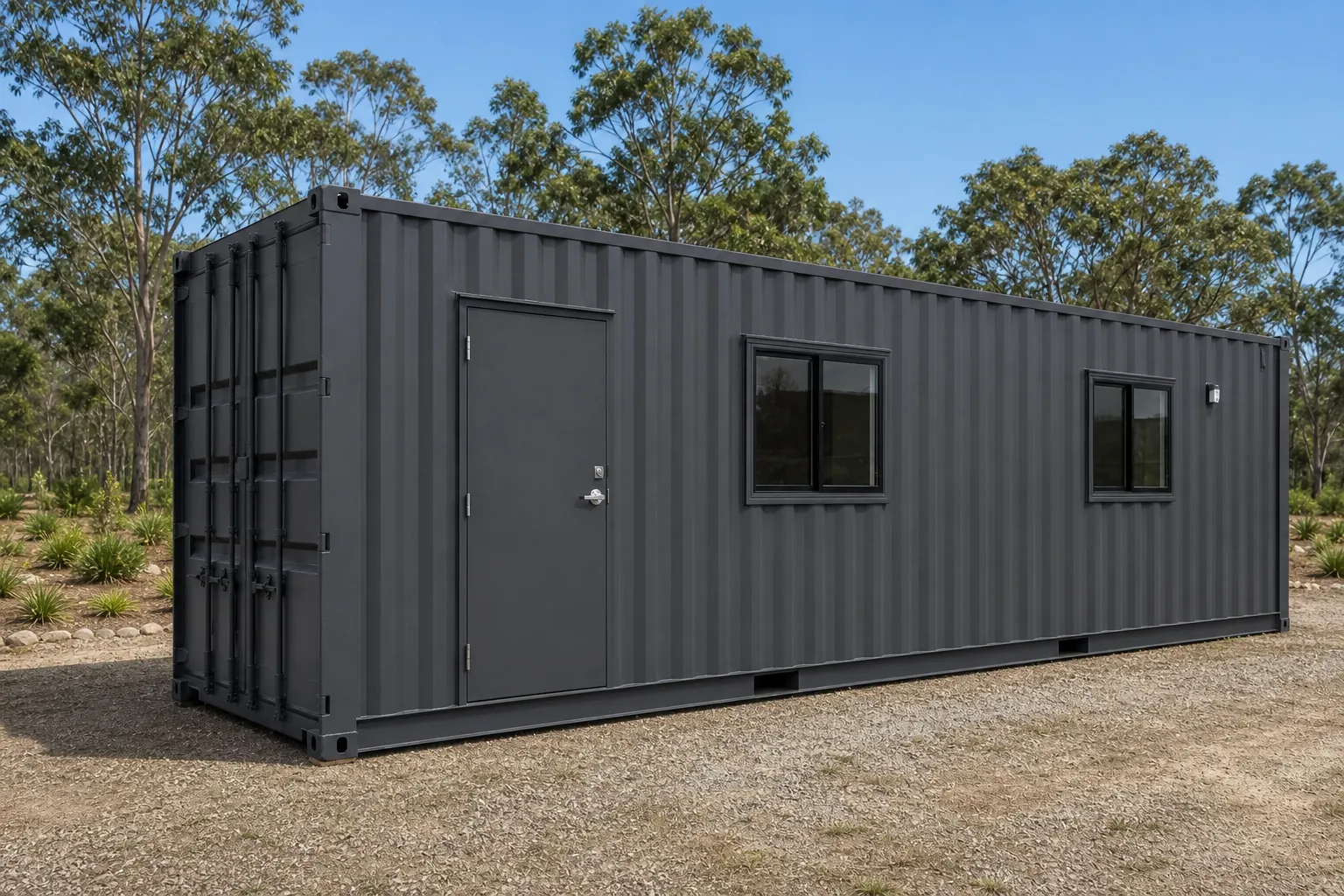
SO40 Container Site Office 40ft
Twelve metres of floor. Run it open for the whole team, or have internal walls fitted before it ships.
4 photos
Factory quote available
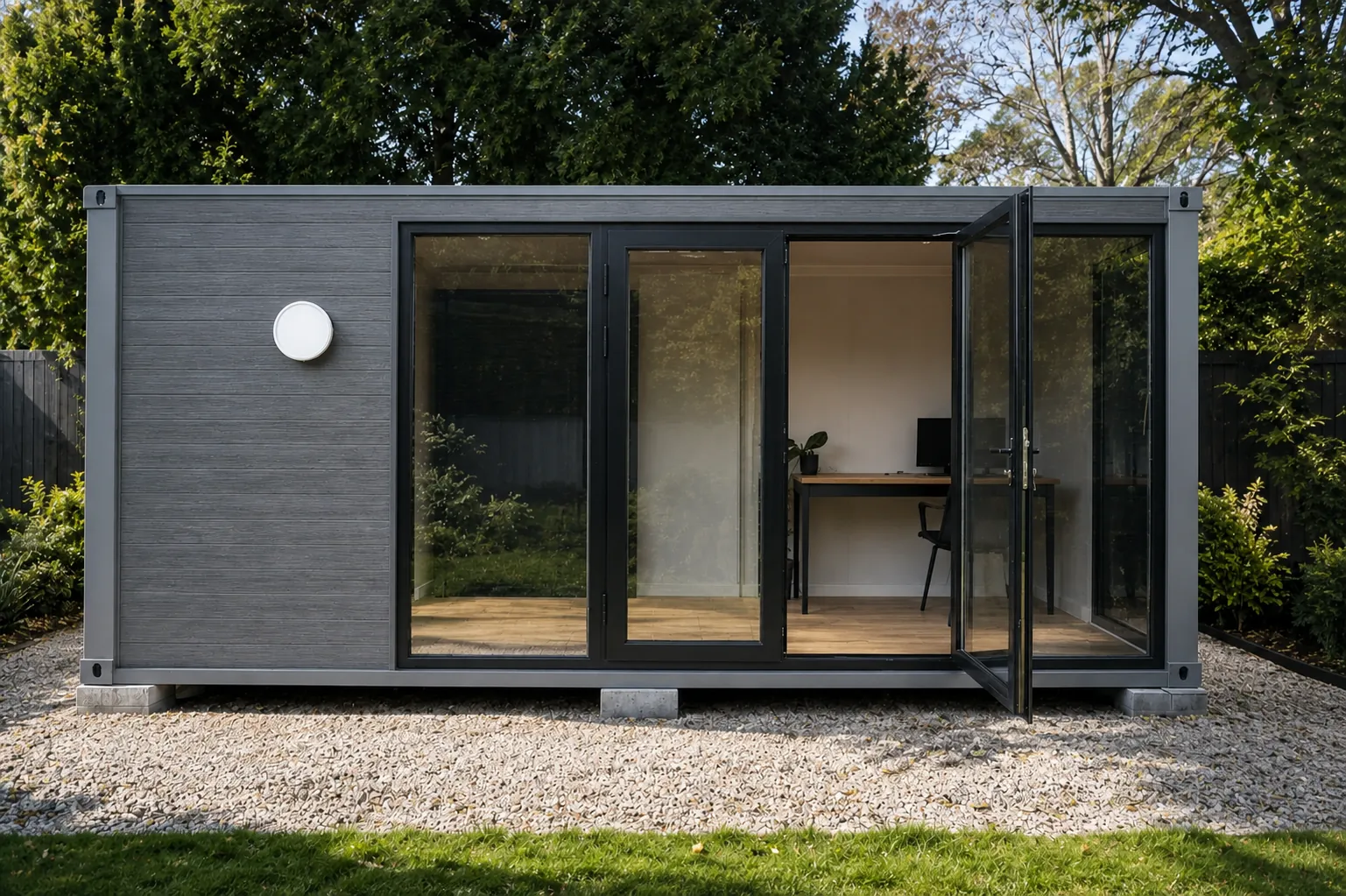
Site Offices Australia
SO6 Portable Site Office 6m
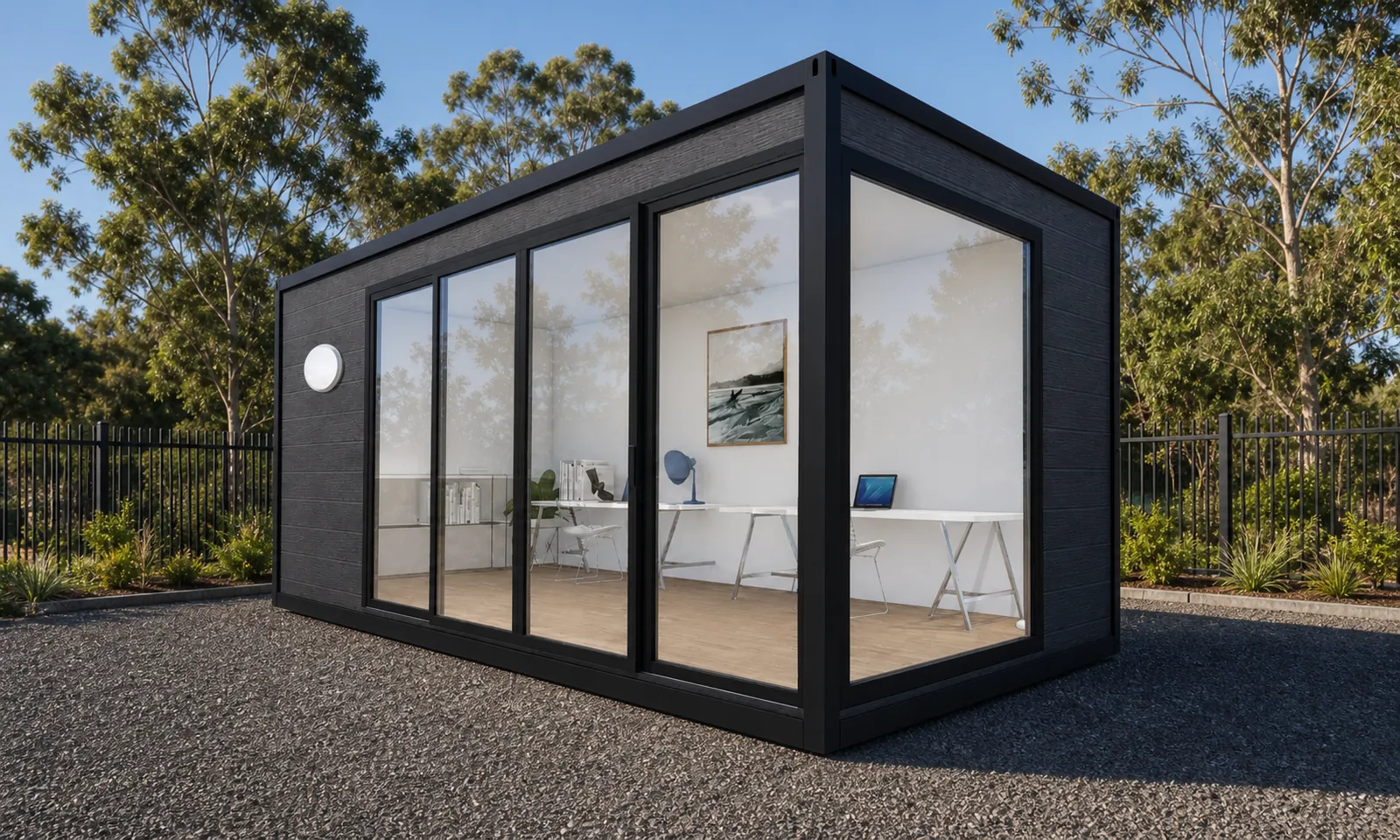
The one you buy when a client walks in. Corner glass on two sides, twin glass doors, timber look floor.
7 photos
Factory quote available
All four are quoted rather than listed, because the freight to your address is as much of the number as the unit itself. Anything bigger than these, or two modules joined into one office, is handled through custom projects.
Folding site containers
Different product, different reason to buy. A folding container arrives as a flat slab on the truck, and two people raise the walls and roof into a 14.6 square metre insulated room with hand tools. Nothing is lined, wired or plumbed. What you are buying is freight economics and speed: folded units stack, so a delivery that moves one finished site office moves several of these, and a crew with no plant on site can have rooms standing the day they land.
They suit construction compounds, mine and remote camps, emergency and disaster deployments, seasonal agricultural crews and hire fleets. They are not homes and we do not sell them as homes. Where a unit is going to be occupied overnight, say so at enquiry, because accommodation is classified and built differently from a store or an office.
The two differ in how they fold, and it changes the building. Compare them on their own pages.
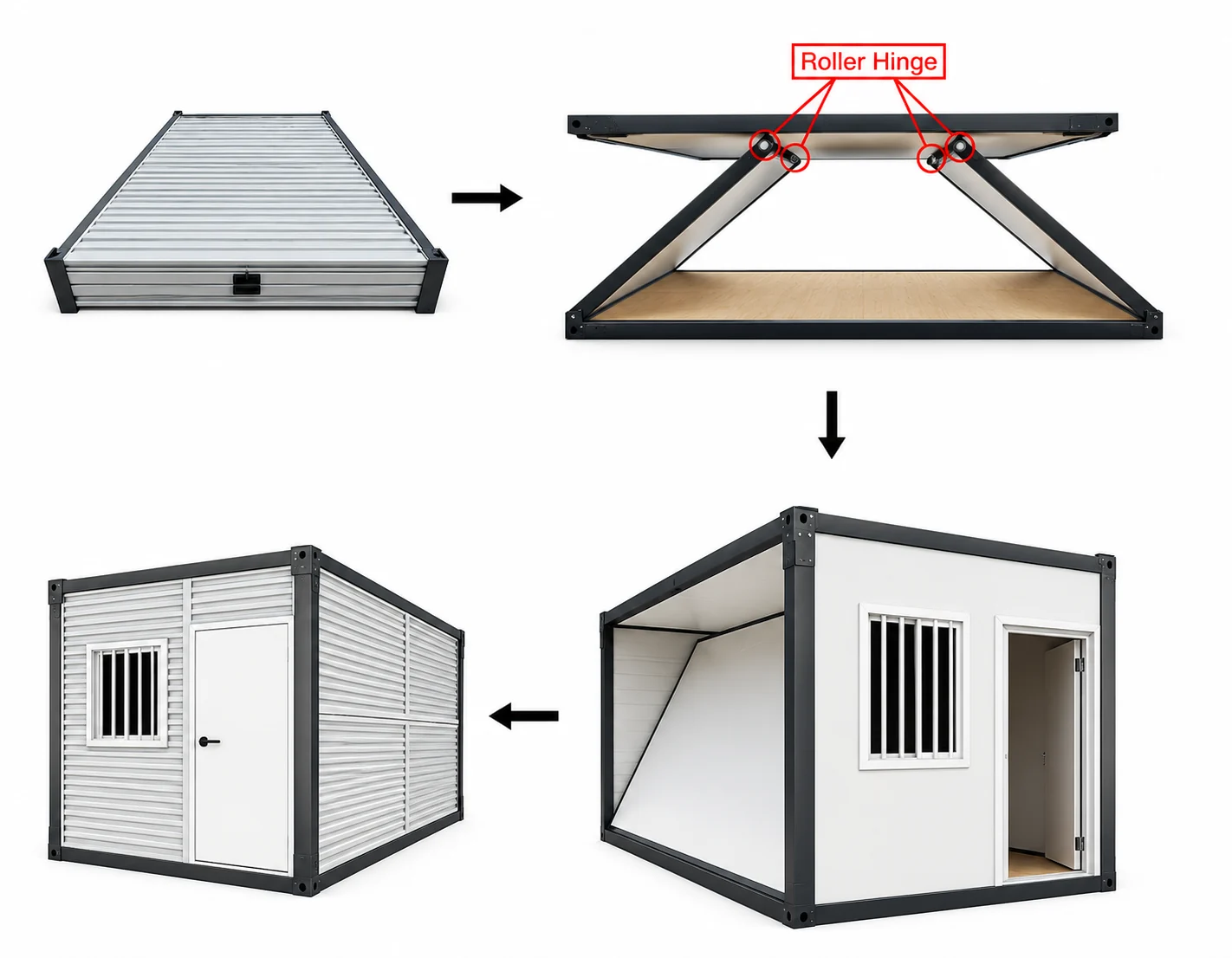
Folding Containers
EX20X X-Fold Rapid Deployment Container 5.9m
Scissors open in one motion. The quickest fold to stand up and the thinnest to pack for freight.
1 photo
Factory quote available
Folding Containers
EX20Z Z-Fold Site Accommodation Container 5.9m
Zigzag fold that locks up rigid. The one specified for camps that stay standing for years.
1 photo
Factory quote available
What a site office actually is
A site office is a room built in a factory and delivered finished. Not a kit, not a shell you fit out yourself on the weekend. It turns up insulated, lined, floored, wired to its own switchboard, lit, air conditioned and lockable, and it comes off the truck by crane or forklift onto whatever you have prepared for it.
That is the whole difference between an office and a shed. A shed keeps rain off tools. A site office is somewhere you can sit through a February afternoon with the door shut, take a call without shouting, keep drawings flat, leave a laptop overnight and lock behind you.
It is a dry room, and that word matters. None of the four models on this page contains a toilet, a shower or a wet crib fit-out, because amenities come as their own unit. It also arrives without desks, chairs, a comms rack, water or waste. What it does arrive with is a switchboard, LED lighting, power points and a mains tail left terminated so a licensed electrician can make it live. Anything that plugs in, sits on the floor or runs to a drain is your side of the line, and that is worth knowing before you set two quotes beside each other.
Site office, site shed, donga or demountable: what people actually mean
Six words for roughly one building. Which one you use says more about where you work than about what you are buying.
-
Site office. The manager’s room, and the term most of the country types into a search bar.
-
Site shed. The same building under the eastern states builder’s word. A carpenter in Melbourne asking for a site shed means the office, not the locked box of tools beside it.
-
Donga. The Western Australian and Queensland word, carried into Australian English through mining and civil work, and almost never printed in a brochure. It now covers any relocatable steel framed room: an office, a crib room or a sleeper.
-
Demountable, or transportable. The hire industry’s word. Usually a panelised cabin on skids that gets trucked in, levelled, bolted down and taken away again when the job finishes.
-
Project office. Not a size, a count. Two or more modules joined on site to make one office for a large team.
-
Gatehouse, security hut, weighbridge cabin, first aid room, sales suite. Same building again, named after the job it does rather than the way it was made.
We build all of them. The word changes at the state border and between trades. The building underneath does not, so use whichever word your crew uses and we will know what you mean.
What size site office does your crew need?
Work backwards from desks, not from square metres. Metres sound generous on a listing and disappear the moment you put a filing cabinet against a wall.
| Model | Internal floor | Realistic desks | Who it suits |
|---|---|---|---|
| SO10 | About 6.5 m² | One desk plus a print bench | A gatehouse, a weighbridge cabin, a first aid room, or a one person foreman’s office where nobody else needs to sit down. |
| SO20 | About 13.5 m² | Two to four | The standard site office. Filing along one wall, a small meeting corner at the far end, and space to spread a drawing out. |
| SO6 | About 13 m², 2.4 m ceiling | Two to four | The same crew as an SO20, in a room a buyer or a council officer is going to walk into and form an opinion about. |
| SO40 | About 28 m² | Four to eight | A full project team. Or ask for internal walls before it ships and get a work area plus a closed room for meetings or a crib space. |
Here is the constraint nobody puts in a listing. A shipping container is roughly 2.35 m wide inside once the walls are lined, whatever its length. One box is therefore always a corridor: desks down one side, a walkway down the other, no matter how many metres the ad quotes. It works honestly up to about six desks. Past that you are not buying a longer box, you are buying two or three joined together with the shared wall out, which changes the crane, the freight and the engineering all at once. If that is where you have landed, start at custom projects rather than squeezing the team into a 40ft.
Container shell or panelised cabin
Container, which covers the SO10, SO20 and SO40. Welded steel with ISO corner castings and forklift pockets, built from the outset to be picked up, set down, shoved across a yard and picked up again. That is why civil, mining and council crews keep ordering them: the box genuinely does not care. It also looks exactly like what it is, which on an active construction site is the point rather than the problem.
Panelised, which is the SO6. A steel frame with EPS insulated wall panels, woodgrain composite cladding, full height double glazed corner glass, an aluminium framed glass sliding door and a hinged glass door, timber look vinyl over a magnesium board composite subfloor, and a hardwired smoke alarm. About 2,120 kg, and it still carries corner castings, so it lifts and relocates the same way. Order it when the room is doing sales work: a display village suite, a developer’s presentation office, a yard office the boss is happy to bring a client into.
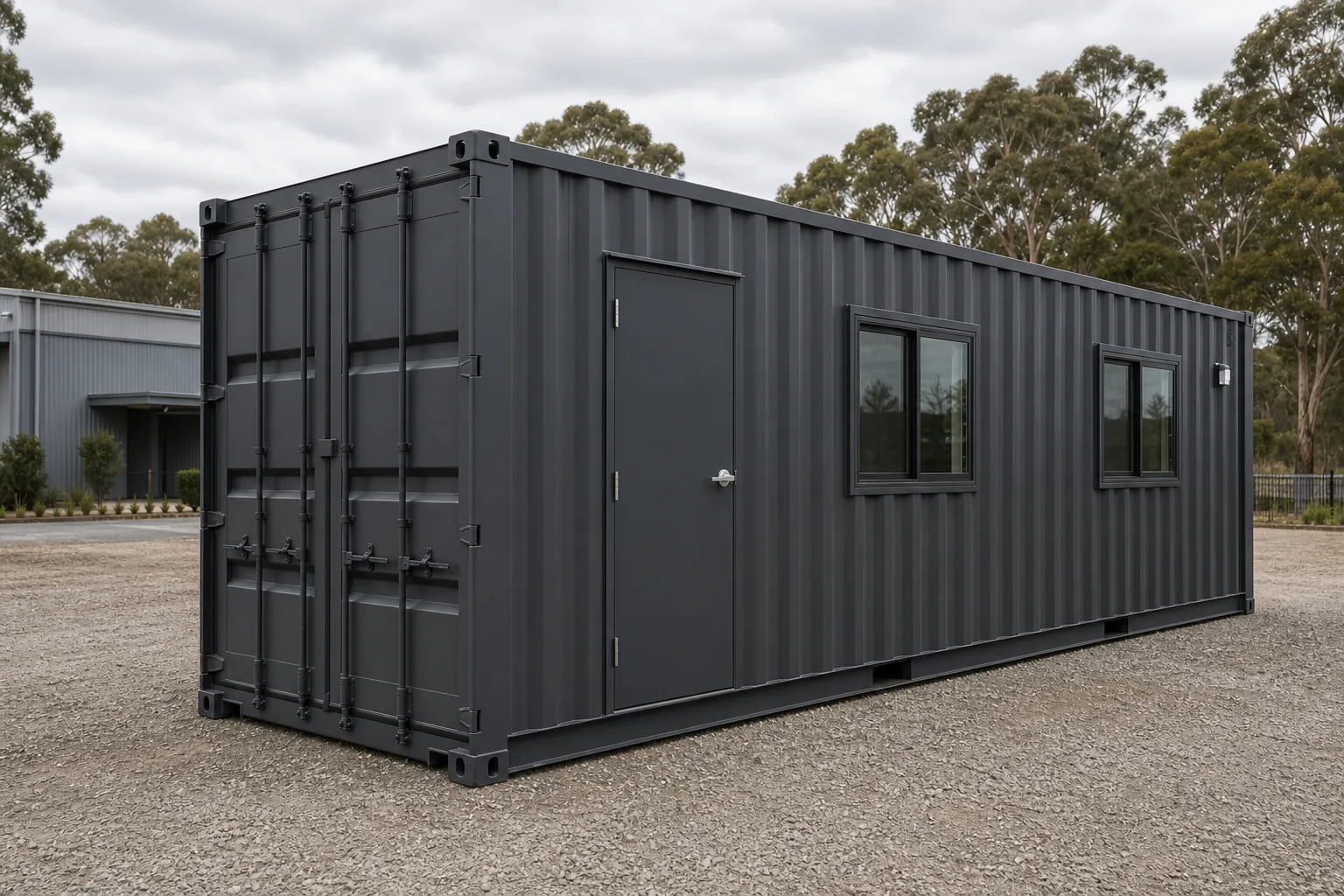
How a container gets cut for openings, re-framed in steel and then fitted out is a build story of its own, and it is set out on the modified shipping containers hub along with the other buildings we make from a container shell.
When buying a site office from us is the wrong call
We would rather lose the enquiry than take a deposit on a job we are the wrong answer to. Eight situations where somebody else will serve you better, and it costs us nothing to say so.
You need it on site next week
Ours run about 40 to 60 days from order to your address. A local hire yard can drop one tomorrow off existing stock. On a genuine deadline they win and it is not close.
You only need it for eight weeks
Short job, fixed end date, no interest in owning an asset afterwards. That is a hire, not a purchase. We do not hire, so there is nothing here for you.
You want a second hand one
Everything we supply is built new to your order. We hold no used stock, run no yard and do not broker ex-hire units, so a second hand search should start with your local dealers.
You need a toilet inside it
These are dry offices with no plumbing. Amenities come as their own unit, and the ablution blocks and portable toilets ranges are built for exactly that.
The site has no room for a truck and a lift
Every unit arrives whole and is craned or forklifted into position. A tight rear lane, low powerlines or an unsealed slope with no set-up room can rule out delivery before we talk about anything else.
You want to fit it out yourself
We do not sell empty shipping containers for you to line and wire, because a container depot will supply that box far more cheaply than we can. The one exception is the folding containers further down this page, which are sold as shells on purpose.
Somebody is going to sleep in it
A commercial office and a room used for accommodation are classified differently and built differently. If people will stay overnight, look at granny flats and ADUs and say so at enquiry.
You want to walk into a yard and see one first
There is no display yard to visit. You are buying from photographs, drawings and a written scope, with independent inspection available before it ships. Some buyers will never be comfortable with that, and it is fair enough.
None of that is modesty. Every one of those situations ends with a disappointed buyer if we take the order anyway, and a disappointed buyer costs more than the sale was worth.
The approval question
Two very different questions get asked with the same handful of words, and mixing them up is what costs people time.
Temporary, on an active construction site. In most states an office that is there for the duration of the works is dealt with inside an approval you already hold. It sits under the development consent or the construction certificate for the project, or under a temporary structure permit, rather than being assessed as a new building in its own right. That is not automatic and it is not identical in every council. The question worth putting to your certifier before you order is which instrument covers it, and whether a time limit comes attached.
Permanent, staying on the land. Once the office stops being temporary works and becomes a building on the block, it is assessed the way any other building is assessed. Planning approval for the land use and building approval for the structure are two separate hurdles, and clearing one tells you nothing about the other. Which classification applies turns on what happens inside, because an office is not a dwelling and a room somebody sleeps in is not an office.
Every unit is built to order to NCC requirements, and the structure is engineered against the wind region and soil class recorded for your address by an engineer registered in Australia. We supply the compliance documentation to support your application, your certifier issues the approval, and we cannot guarantee approval. No supplier can, and any who says otherwise is selling you something they do not control. What we hand across is itemised on the approval pathway page, and the split between planning and building approval is unpicked on council approval and compliance.
Five ways to get a site office, compared
The honest summary before the table: if you need it inside a fortnight, or the job finishes before Christmas, hire one. Buying is the right call when the office outlasts the job it was bought for, and when you want to choose the specification rather than accept whatever came back off the last contract.
| Option | How long it takes | When it wins | The catch |
|---|---|---|---|
| Buy new, factory direct | About 40 to 60 days from order to site | The office will see job after job, and you want to pick the size, the floor and the layout rather than take what is in a yard. | You wait about two months, and you pay for it once, in full, before it earns anything. |
| Hire from a local yard | Days | Short or uncertain jobs, a hard end date, and no appetite for owning an asset once the site is packed up. | The weekly rate never stops. On a long project the arithmetic turns against it, so work out your own crossover point before you sign. |
| Buy second hand | Days to weeks | Budget is the binding constraint, the unit is going somewhere rough, and appearance is genuinely irrelevant. | You inherit somebody else’s damp, wiring and dents, and a unit nobody kept records for arrives with no compliance documentation behind it. |
| Buy new through an Australian dealer | Weeks | You want a local warranty desk to walk into and you would rather not deal with an import at all. | The same factory sits at the other end of it, with a distributor margin added on top of the price. |
| Build an office on site | Weeks to months, plus trades | You already have the slab, the builder and the approval, and the office is staying put permanently. | Every trade is a separate booking and a separate delay, and none of it moves when the job moves. |
How ordering works
Step one
Tell us the job and the postcode
How many people have to sit in it, whether anyone outside the crew walks in, and where it is going. That is enough to start, and access photos help more than measurements do.
Step two
A written scope and a factory quote
The unit, the inclusions and the freight to your address, in writing. No price list appears on this page because a delivery into Karratha and one into Dandenong land on very different figures.
Step three
Production, then freight
Typical factory production of 20 to 30 days once drawings are signed off, then typical delivery of 20 to 30 days covering sea freight, customs and inland transport. Around 40 to 60 days in total.
Step four
Delivery and set down
It travels whole and comes off the deck by crane or forklift onto whatever you have ready: a compacted pad, sleepers, a slab or piles. A licensed electrician then makes it live.
Delivery and installation sets out what the site has to have in place on the day, and what happens if the access turns out tighter than the photographs suggested.
Site office questions
What is a donga?
In Australia a donga is a relocatable, steel framed room delivered as a finished module. The word came into general use through mining and civil work in Western Australia and Queensland, and it now stretches across site offices, crib rooms and single person sleepers. Ask us for a donga office and you will get the same building somebody in Sydney would call a site shed.
Is a site office the same thing as a site shed?
In everyday use, yes. Site shed is the common builder’s word through Victoria and New South Wales for the office itself. Confusion only creeps in on sites where a plain storage container is also called a shed, so if it matters, say office or say storage and the crew will know which one is arriving.
How many people actually fit in a 20ft site office?
Two to four working comfortably, in about 13.5 m². The limit is not the floor area, it is the roughly 2.35 m internal width of a container, which forces desks down one side and a walkway down the other. Four people fit if two share the far end as a meeting corner. Six is a squeeze that everybody complains about by week three, and at that point the 40ft or a second module is the better answer.
Does a site office need council approval?
It depends on whether it is temporary or permanent, and it varies between states and councils. A temporary office on an active site is usually covered by the consent or permit already issued for the works. An office that stays on the land is normally assessed as a building and needs approval in its own right. Get your certifier to name the pathway that applies at your address while the order is still a conversation. We supply the compliance documentation to support your application, your certifier issues the approval, and we cannot guarantee approval.
Can I hire a site office from you instead of buying one?
No. We build to order and sell outright, with no hire fleet, no weekly rate and no swap outs. Hire is a genuinely good answer for short jobs and we will say so on the phone. If the office is going to outlive this project, or you want a specification chosen rather than allocated, that is when buying starts to make sense.
Do you sell used or ex-hire site offices?
No. Everything is built new against your order, so there is no second hand stock, no yard to walk through and no ex-hire units to inspect. The trade off is a wait of roughly two months in exchange for a unit specified the way you asked for it, with documentation behind it.
Can a site office be moved to the next job?
Yes, and that is the point of the format. The container models keep their ISO corner castings and forklift pockets, so they lift by twistlock or slings and travel on a standard truck at standard freight rates, and the SO6 carries corner castings too. The second site asks for what the first one did: ground firm enough to take the truck, clear space alongside where it sets down, and a lift path with nothing strung across it.
Do you deliver to Perth, the Pilbara, Darwin, Mackay and other regional sites?
Yes, Australia wide, and much of this work is regional or remote by nature. Freight is quoted to your address rather than to the nearest capital, because the inland leg is the part that moves the number most. Send the delivery address and photographs of the access with your enquiry so the quote reflects the real job.
Where to go next
Compare the four models directly: SO10 10ft, SO20 20ft, SO40 40ft and the SO6 6m panelised office. If the office is only half of what the site needs, the ablution blocks and portable toilets ranges cover amenities, and modified shipping containers covers everything else we build from a container shell. Anything larger or joined together starts at custom projects, and the whole catalogue is on our range. If a bare folding shell is what the job actually needs, compare the EX20X X fold and the EX20Z Z fold.
Get a Quote
Tell us how many desks, whether clients walk in, and the delivery postcode. We come back with a written scope and the freight to your address.