
Tiny home on wheels setup costs are the spend that sits either side of the home itself: registration, a level base, power, water, wastewater and delivery. Most of it is site-specific. Registration is the only genuinely predictable line, and the wastewater decision is usually the largest single variable on the list.
Buyers research the home and rarely research the setup, which is the wrong way around. Two identical homes on two blocks can have setup costs that differ by an order of magnitude. A flat backyard behind an existing house with a spare circuit is close to free. A sloping rural block with no sewer is not.
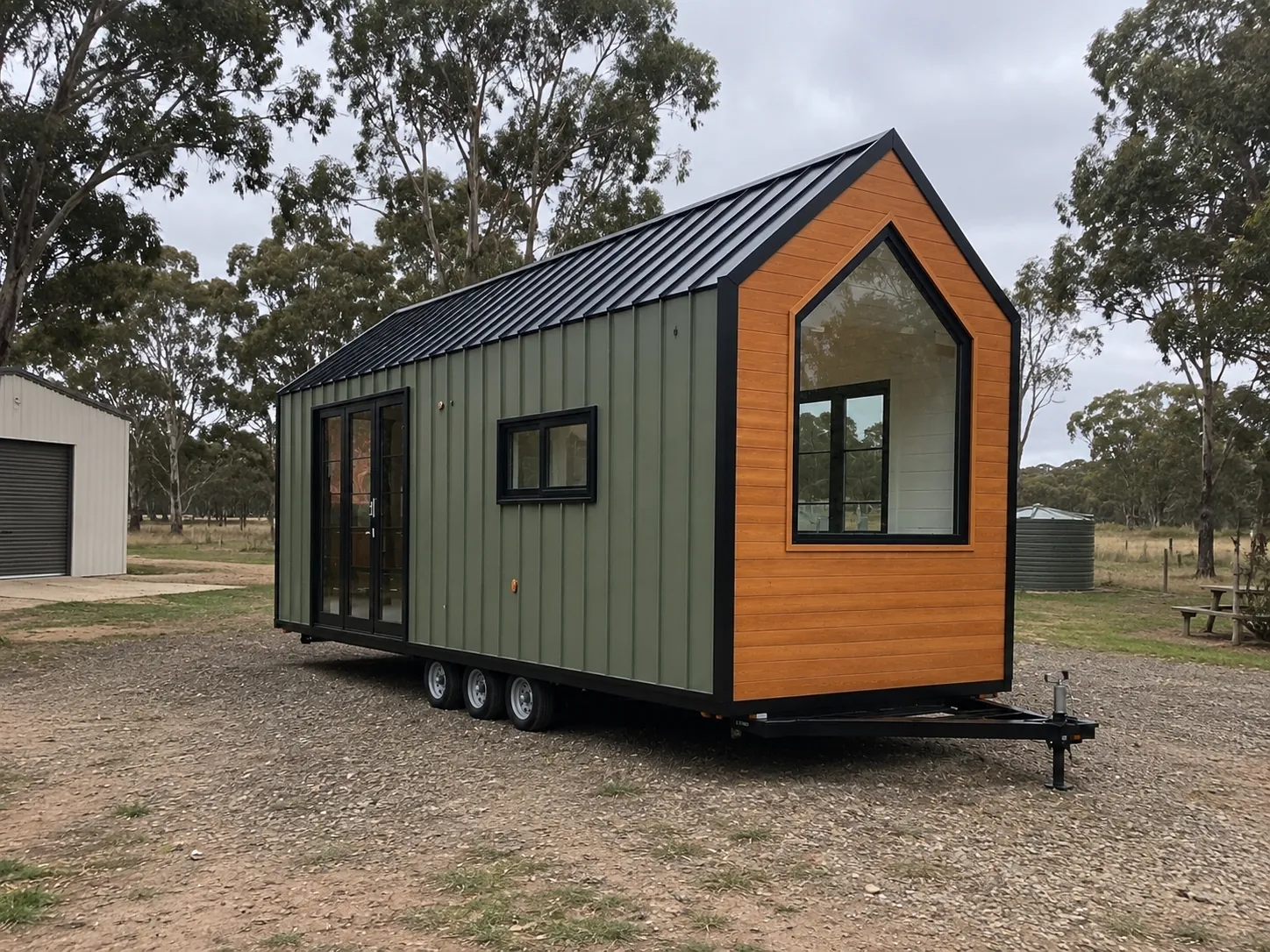
What do tiny home on wheels setup costs actually cover?
Six lines cover almost everything: registration and compliance, the base the home sits on, electrical supply, water supply, wastewater, and delivery. Insurance and towing are the two recurring items people forget.
Only the home itself is quotable in advance. Everything else depends on your block and is done by local trades you engage directly. When comparing suppliers, check you are comparing the same scope: a headline figure that quietly excludes delivery and a base is not comparable to one that includes them. Our tiny house cost guide covers how to read a quotation; this article deals only with what happens on your land. If wheels are not settled yet, tiny house on wheels vs a fixed tiny home is the decision that sits in front of this one.
What does registering a tiny home on wheels cost each year?
Registration is an annual cost driven by tare weight, and it is the one line you can look up exactly. New South Wales charges a flat fee plus a vehicle tax stepped by tare weight, with a 40 per cent reduction already applied to privately registered caravans and purpose-built camper trailers.
| Tare weight | NSW vehicle tax (private caravan, 40% reduction applied) |
|---|---|
| Up to 254 kg | $0 |
| 255 to 764 kg | $94 |
| 971 to 1,150 kg | $188 |
| 1,500 to 2,500 kg | $330 |
| 2,501 to 2,790 kg | $516 |
| 2,791 to 3,050 kg | $586 |
| 3,301 to 3,560 kg | $699 |
| 3,561 to 3,810 kg | $750 |
Source: Transport for NSW vehicle registration fees, nsw.gov.au, checked August 2026. A flat registration fee of $84 applies on top, and fees rise 2.65 per cent from 1 July 2026.
A typical two-axle tiny home lands between 2,800 kg and 3,500 kg tare, so in NSW that is roughly $670 to $780 a year all up. Two things soften it. Trailers do not need their own compulsory third party green slip in NSW, because injury liability while towing is picked up by the tow vehicle’s policy. And the 40 per cent caravan reduction is applied automatically.
Before first registration you also need a Vehicle Identification Number and an identity inspection, and the process differs by state. Victoria requires a physical vehicle identity inspection at a service centre for trailers between 751 kg and 4,500 kg ATM. Check your own transport authority’s published fee schedule rather than an interstate figure.
What does the base under the home cost?
The base is the cheapest line if your ground is already level and the most expensive if it is not. A tiny home on wheels does not need footings, but it does need bearing.
The home sits on levelling legs, which concentrate the load into a handful of small points. On firm level ground, concrete pads or heavy pavers under each leg are enough. On soft, sloping or reactive ground you are into excavation, a compacted gravel pad, retaining or screw piles, and the cost climbs with the slope. VSB1 requires a minimum running clearance of 100 mm, so you also need drainage that moves water away from under the chassis.
Be careful how permanent you make this. A gravel or paver base keeps the home clearly a vehicle. A poured slab with the wheels removed and a deck framed into the structure is how a home stops being a vehicle and becomes a building that needed approval.

What do power, water and wastewater cost?
Power and water are usually straightforward. Wastewater is where the real money is, and it is the line that most often decides whether a site works at all.
A tiny home on wheels is normally designed around a 15 amp lead into a dedicated outlet. If a house is already on the block, a licensed electrician running that circuit is a half-day job. If there is no supply at all you are into a new distributor connection or an off-grid solar and battery system, and the gap between those two is enormous. Water is the same story: a garden tap on a serviced block, versus tanks and a pump where there is no mains.
Wastewater carries the real cost. VSB1 is explicit that a caravan’s toilet must not discharge onto the road, so the home leaves the factory self-contained. On site there are three realistic paths.
- Composting or incinerating toilet plus greywater management. Published Australian supplier guides put these units in the $1,000 to $5,000 range depending on model and installation. Lowest cost, most user involvement.
- Connect to existing sewer or an existing on-site system. Usually cheapest where a house is already on the land, but it needs a licensed plumber and, in most states, approval to alter the existing system.
- New on-site treatment system. Express Wastewater Solutions publishes indicative South East Queensland figures of $11,000 to $15,000 installed for a surface-irrigation home sewage treatment plant, $13,000 to $16,000 for a subsurface system, and $22,000 to $30,000 to replace a septic tank with a treatment plant, excluding plumbing to the tank (expresswastewater.com.au, checked August 2026).
The same guide puts running costs at roughly $1,000 a year averaged over 15 years: about $300 a year in electricity for the pump and aerator, and about $600 every five years to replace them. That is a real ongoing number to sit next to your registration cost.
What does delivery cost?
Delivery is a towing job rather than a crane job, and the cost is driven by distance and by whether your tow vehicle is legally rated for the load.
Weight decides this. VSB1 requires trailers over 2,000 kg gross trailer mass to have brakes on all wheels and a breakaway system that keeps them applied for at least 15 minutes. A dual-cab ute is typically rated to tow 3,500 kg braked, so a home built to a 4,500 kg ATM cannot legally be towed by one. For most tiny homes on wheels the answer is a professional transport operator with a rated vehicle, quoted per kilometre plus access difficulty. A shorter model such as the TW74P veranda tiny home on wheels keeps more tow vehicles in play than a two-bedroom layout like the TW110.
Access on the day is the other variable: a clear 2.5 metre width the whole way in, a turning circle for a trailer up to 12.2 metres long, and ground firm enough that the truck does not bog. Walk it before you order, because a delivery that cannot be completed is still charged for.
The setup cost stack at a glance
| Line | When you pay | Published reference figures |
|---|---|---|
| VIN and identity inspection | Once, before registration | Varies by state |
| Registration and vehicle tax | Every year | NSW: $84 plus $0 to $750 by tare weight |
| Insurance | Every year | Caravan or RV policy, not home insurance |
| Base and levelling | Once, before delivery | Pads on level ground, screw piles on slope |
| Electrical | Once | Dedicated 15 A circuit, new connection, or solar |
| Water | Once | Garden tap, or tanks and a pump |
| Wastewater | Once, plus running cost | $1,000-$5,000 composting; $11,000-$16,000 new plant; about $1,000 a year to run |
| Delivery | Once | Professional tow above most utes’ 3,500 kg rating |
For scale, the ABS recorded 18,328 dwelling approvals nationally in June 2026 and $10.42 billion of new residential building value, an average of roughly $569,000 of building work per approved dwelling (ABS, Building Approvals, Australia, June 2026, seasonally adjusted). Against that, the whole setup stack is a small number, but it is still one you should have before you order.
What can you leave out?
You can defer landscaping, decking, carports and rainwater harvesting. You cannot defer the base, the electrical work, the wastewater path or the registration, and trying to means either an unusable home or an unregistered one.
Check early whether your block permits the home to stay. In New South Wales the long-stay exemption for one caravan applies where there is already a dwelling house on the land and the tiny home is occupied only by the owner or members of the owner’s household. If your plan is a rental, or a home on a vacant block, this cost list changes completely, because you are then building a building. At that point the rules that apply are the secondary dwelling ones, which differ by state: see granny flat rules in Australia by state. Our portable tiny house guide and the full tiny homes on wheels range explain which models suit which pathway, and the 10 metre TW100 is a good reference for a single-household setup.
On timing, plan for typical factory production of 20-30 days and typical delivery of 20-30 days, around 40-60 days in total from order to site, which is usually enough lead time to get the base and services done in parallel. Compliance is collaborative and site-dependent, and final approval rests with your certifier or council. For the home itself, price on request; for anything outside the range see custom projects.
Frequently asked questions
Do I need to register a tiny home on wheels if I never tow it?
Not to sit on private land, but registration keeps it clearly in the vehicle category. Councils generally look at whether the home is capable of being registered and moved, so keeping it registered is the simplest way to show it is a moveable dwelling rather than a building.
Can I insure it on my home and contents policy?
Generally no. It is insured as a caravan or under a specialist recreational vehicle policy, and not every insurer covers full-time living. Tell the insurer up front that it is a permanent residence, because a policy written for touring may not respond the way you expect.
What is the biggest single setup cost?
On an unserviced block, a new on-site wastewater treatment system: published indicative figures run from $11,000 to $16,000 for a new system, and $22,000 to $30,000 where an old septic tank has to be replaced. On a serviced block with an existing house, the base and the electrical work are usually the largest lines.
Does adding a third axle change the annual registration cost?
Indirectly, yes. NSW vehicle tax is stepped by tare weight rather than axle count, but a tri-axle chassis is heavier and usually carries a heavier home, so it lands in a higher bracket. Moving from the 2,791 to 3,050 kg bracket to the 3,561 to 3,810 kg bracket is $164 a year on the published NSW figures.
Recommended products for you
Tiny homes on wheels from our range.

Tiny Homes on Wheels
TW100 Tiny Home on Wheels 10m
A 10 m tiny home on wheels supplied complete on its own heavy steel trailer.
2 photosFactory quote available
View this model
Tiny Homes on Wheels
TW110 Two Bedroom Tiny Home on Wheels 11m
An 11 m towable home with a ground floor bedroom and a full width sleeping loft.
9 photosFactory quote available
View this model
Tiny Homes on Wheels
TW74 Loft Tiny Home on Wheels 7.4m
A 7.4 m towable tiny home with a queen loft and a choice of ground floor layouts.
10 photosFactory quote available
View this model
Tiny Homes on Wheels
TW74P Veranda Tiny Home on Wheels 7.4m
A 7.4 m towable tiny home with a covered veranda and up to three sleeping zones.
8 photosFactory quote available
View this model
Tiny Homes
TH4 Studio Pod 4m
Desk plus meeting corner, and the first size that takes a bathroom.
7 photosFactory quote available
View this model
Tiny Homes
TH6 Studio Cabin 6m
The size where a work pod turns into a cabin you can sleep a guest in.
8 photosFactory quote available
View this modelGet a quote
Tell us your postcode and what the block is like. We come back with a written quote covering the unit and the freight to your address.