
The choice between a tiny house on wheels vs fixed tiny home comes down to legal category, not size. A home on a registered trailer follows vehicle and moveable-dwelling rules, which are different from the approval pathway for a fixed building. Site placement and occupation conditions still apply and vary by jurisdiction. A fixed tiny home is a building: it needs consent and can be any shape.
Both can give you a one or two bedroom home under 40 square metres. What separates them is the paperwork, and the paperwork decides how wide the home can be, where it sits, who may sleep in it, and whether you can move it later.
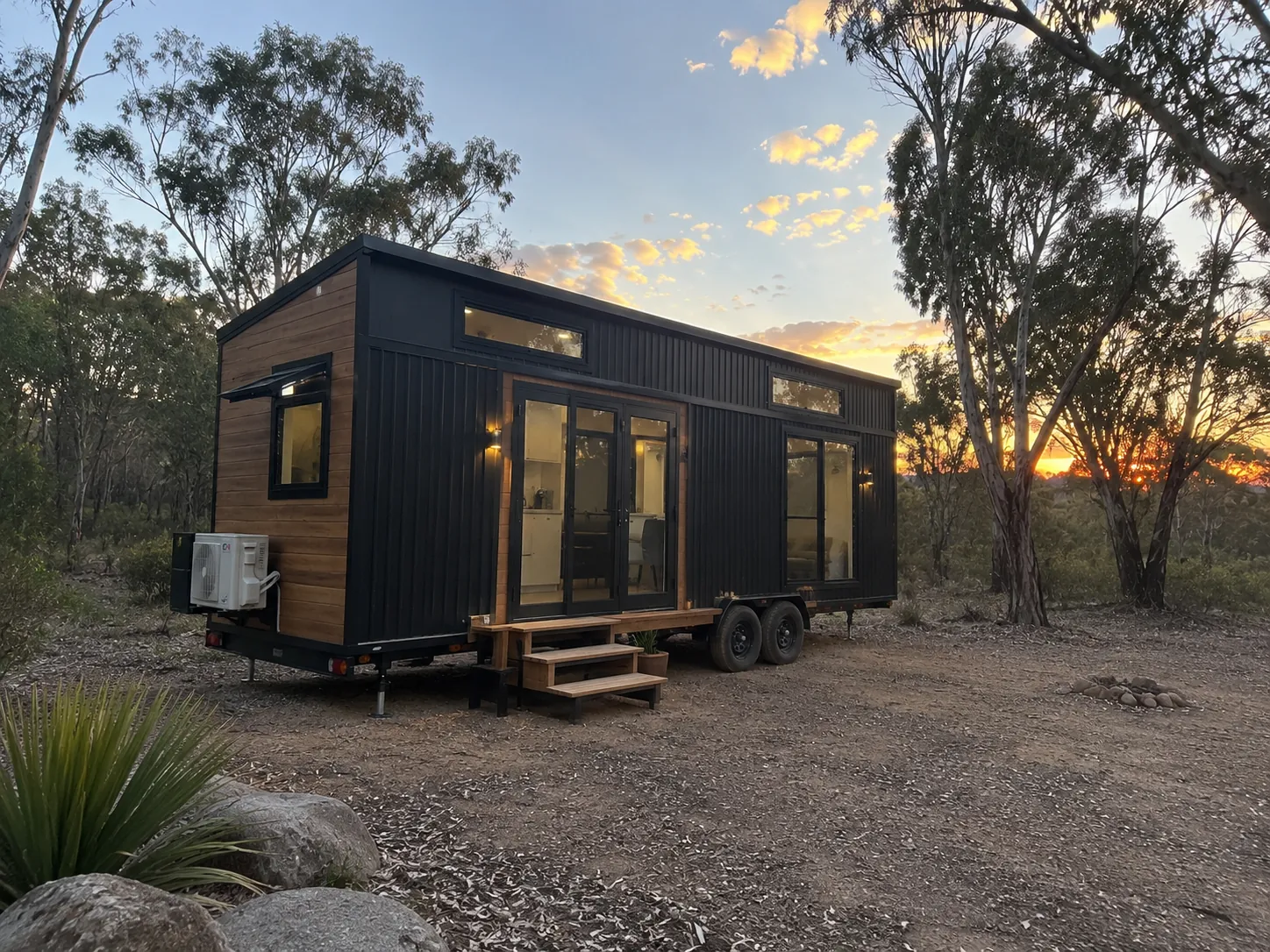
What actually separates a tiny house on wheels from a fixed tiny home?
The difference is which body of law governs it. A tiny house on wheels is regulated as a vehicle; a fixed tiny home is regulated as a building.
Vehicle Standards Bulletin 1 (VSB1) Revision 6, issued by the federal Department of Infrastructure in September 2024, defines a caravan as an enclosed trailer intended for use as a mobile home or living quarters when it is parked. A tiny home on a trailer with an aggregate trailer mass (ATM) of 4,500 kg or less sits inside that definition: registered, carrying a Vehicle Identification Number, built to the Australian Design Rules.
A fixed tiny home is the opposite. It sits on footings or piers, it is connected to services, and it is assessed as a Class 1a building under the National Construction Code. In New South Wales the split is written into the legislation: moveable dwellings sit under the Local Government Act 1993, buildings under the Environmental Planning and Assessment Act 1979.
How big can a tiny house on wheels be before it stops being road legal?
A towable tiny home has to fit inside the light trailer envelope, and that envelope is tighter than most people expect. The figures below come from VSB1 Revision 6, chapter 5.
| Limit | Figure | What it includes |
|---|---|---|
| Maximum width | 2,500 mm | Across the body, including mudguards, racks and awnings |
| Maximum height | 4,300 mm | Includes a roof-mounted air conditioner |
| Maximum length (pig trailer) | 12,200 mm | The standard caravan configuration |
| Maximum drawbar length | 8,500 mm | Measured to the coupling |
| Minimum running clearance | 100 mm | Ground to the lowest sprung point |
| Scope of VSB1 | ATM 4,500 kg or less | Above this, heavy vehicle rules apply |
The 2.5 metre width shapes every floor plan. Internal width after wall build-up lands close to 2.3 metres, which is why towable designs put the bathroom across one end and run everything else in a single line. A fixed tiny home has no such ceiling. Compare a towable layout such as the TW74 loft tiny home on wheels against a fixed cabin like the TH6 studio cabin and the difference is the first thing you notice.
VSB1 also carries requirements most buyers never hear about until an inspection. Caravans may have only outward-opening or sliding doors, and at least one door must be on the left-hand side or at the rear. Each one must carry a fire extinguisher rated 1A:5B to AS 2444-1985, and two if multi-compartment. Toilets must not discharge onto the road and sinks must not drain into the toilet tank. Above 2,000 kg gross trailer mass the brakes must operate on all wheels, with a breakaway system that holds them on for at least 15 minutes.
Which one needs approval from your council?
A fixed tiny home generally follows the planning and building approval pathway. A tiny house on wheels follows vehicle and moveable-dwelling rules, with separate registration, site and occupancy conditions. Do not assume that neither approval is required.
New South Wales sets out the clearest version of those limits. Clause 77 of the Local Government (Manufactured Home Estates, Caravan Parks, Camping Grounds and Moveable Dwellings) Regulation 2021 allows one caravan to be installed without approval on land occupied by the owner in connection with the owner’s dwelling house, if it is used for habitation only by the owner or members of the owner’s household. Separately, up to two caravans, campervans or tents may be installed without approval if they are not occupied for more than two days at a time and not more than 60 days in total in any 12 months.
Those two limbs carry three conditions that catch people out. There has to already be a dwelling house on the land. Only your own household may live in the tiny home. Anyone outside that household is a short-stay visitor, capped at two days at a time. Other states run the same logic through different instruments, and Queensland councils in particular vary widely on whether permanent occupation of a caravan on a residential lot is accepted at all.
The moment the home stops behaving like a vehicle, the exemption stops applying. Removing the wheels, casting a slab under it, hard-plumbing it into sewer or framing a deck into the structure are all ways a council can reasonably decide you have built a building. If that is where you are heading, it is cheaper to start with a fixed tiny home or a proper granny flat and do the approvals once. What that second path involves differs by state, and granny flat rules in Australia by state sets out the caps and lot sizes.
Can you actually live in a tiny house on wheels full time?
Long-term occupation rules vary by state and council. It may require an existing dwelling, limits on who may occupy the tiny home, a separate approval, or a different moveable-dwelling pathway. That single restriction rules out the two uses buyers most often have in mind.
You cannot use the exemption to put a tiny home on wheels on a vacant block as your only residence: with no dwelling house on the land, the first limb of clause 77 does not apply and you are into a development application. You also cannot rent it out. Once the occupant is a tenant rather than a household member, the home is a second dwelling and needs consent. If rental income is the plan, a fixed secondary dwelling is the honest pathway.
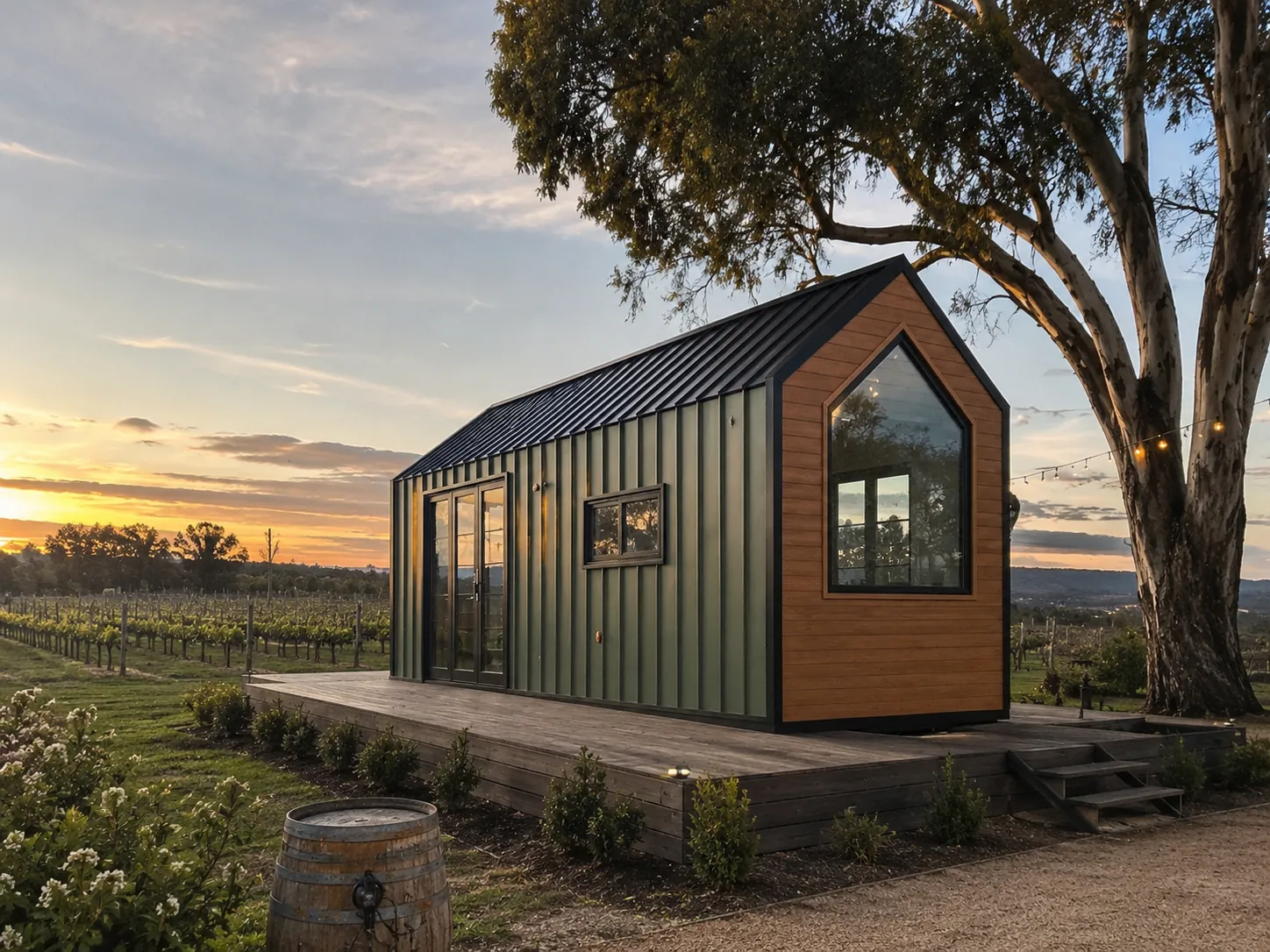
What does each option demand from your block?
A tiny house on wheels demands access; a fixed tiny home demands engineering. Those are two very different site problems.
For a towable home, walk the route before you order. You need a clear 2.5 metre width the whole way, overhead clearance for a roof approaching 4.3 metres, a turning circle for a trailer up to 12.2 metres long, and ground firm enough to take the axle loads. Side access down a suburban boundary is the usual failure point.
A fixed tiny home skips all of that and picks up different obligations. It needs a site classification under AS 2870 and a wind classification under AS 4055. Structural design is certified by an Australian registered engineer for your site’s wind and soil classification. We supply the compliance documentation to your building certifier or surveyor, who issues the approval. Our fixed models are built to order to NCC Class 1a requirements, compliance documentation supplied.
Services split the same way. A towable home runs off a 15 amp lead, a garden tap and a self-contained or composting waste system. A fixed home such as the TH95 capsule home gets a permanent electrical connection and is plumbed to sewer or an on-site system: more work up front, far less every week afterwards.
Tiny house on wheels vs fixed tiny home: side by side
| Factor | Tiny house on wheels | Fixed tiny home |
|---|---|---|
| Legal category | Vehicle (caravan or light trailer) | Building |
| Governing rules | VSB1, Australian Design Rules, road law | National Construction Code, planning law |
| Maximum width | 2,500 mm | No road-based limit once on site |
| Approval | Distinct vehicle and moveable-dwelling route; state and council site and occupancy conditions apply | Planning consent and building approval |
| Who can live in it | Owner’s household; NSW caps others at 2 days at a time | Anyone, including tenants, once approved |
| Existing house needed on the land | Yes, for the long-stay exemption | No |
| Ongoing cost | Registration and vehicle tax | Rates on the improved value |
| Site works | Level, firm ground and towing access | Footings designed to AS 2870 and AS 4055 |
| Waste | Self-contained, composting or cassette | Plumbed to sewer or an on-site system |
| Moving it later | Tow it | Crane and transport |
Which one suits your block?
Consider a home on wheels where the relevant council or authority confirms that the intended site, occupants and length of stay fit the moveable-dwelling pathway, and where you need a relocatable home with clear 2.5 metre access. The 10 metre TW100 is designed around that brief, and the full range sits on our tiny homes on wheels page. Before you commit, price the ground under it: tiny home on wheels setup costs covers the base, the services and the annual registration.
Choose fixed if the block is vacant, if you want to rent the home out, if you want more than 2.5 metres of width, or if you are adding permanent value a valuer will recognise. Our guide to tiny houses in Australia covers where each format fits. Once width stops being a towing problem the glass-heavy formats open up, and where mirror houses and glass capsule homes suit covers what they ask of a block. At the small end of the fixed range the TH3 studio pod and the TH4 studio pod are the two that fit a backyard a towable would struggle to reverse into.
Either way the build clock is the same: typical factory production of 20-30 days and typical delivery of 20-30 days, around 40-60 days in total from order to site. Compliance is collaborative and site-dependent, and final approval rests with your certifier or council. Pricing is a factory quote available on request.
Frequently asked questions
Is a tiny house on wheels covered by the National Construction Code?
The NCC building pathway generally applies to buildings, while a registrable moveable dwelling can follow a different state and local regulatory route. That does not make it unregulated or automatically exempt from approval. Confirm the classification, site and occupation conditions with the relevant authority before ordering.
Can I put a tiny house on wheels on a vacant block?
Not as a permanent residence without approval. The long-stay exemption in NSW is tied to an existing dwelling house on the land. On a vacant block you are limited to the short-stay provision of two days at a time and 60 days in any 12 months, unless you lodge a development application.
Which one holds its value better?
A fixed tiny home is an improvement to real property and is picked up in a valuation of the land. A tiny house on wheels is a chattel, valued the way a caravan is valued, separately from the land. That also means it is financed and insured as a vehicle rather than as part of a mortgage.
How wide can a tiny home be if I never need to tow it?
As wide as your site, setbacks and transport route allow. Once the home is craned in rather than towed, width limits only affect the one-off delivery, and an oversize permit can carry a module wider than 2.5 metres. See custom projects for what is possible when the design starts from the site.
Recommended products for you
Tiny homes on wheels from our range.

Tiny Homes on Wheels
TW74 Loft Tiny Home on Wheels 7.4m
A 7.4 m towable tiny home with a queen loft and a choice of ground floor layouts.
10 photosFactory quote available
View this model
Tiny Homes on Wheels
TW74P Veranda Tiny Home on Wheels 7.4m
A 7.4 m towable tiny home with a covered veranda and up to three sleeping zones.
8 photosFactory quote available
View this model
Tiny Homes on Wheels
TW100 Tiny Home on Wheels 10m
A 10 m tiny home on wheels supplied complete on its own heavy steel trailer.
2 photosFactory quote available
View this model
Tiny Homes on Wheels
TW110 Two Bedroom Tiny Home on Wheels 11m
An 11 m towable home with a ground floor bedroom and a full width sleeping loft.
9 photosFactory quote available
View this model
Tiny Homes
TH6 Studio Cabin 6m
The size where a work pod turns into a cabin you can sleep a guest in.
8 photosFactory quote available
View this model
Tiny Homes
TH9 Designer Pod 9m
A one room granny flat with a full kitchen, a full bathroom and real kerb appeal.
8 photosFactory quote available
View this modelGet a quote
Tell us your postcode and what the block is like. We come back with a written quote covering the unit and the freight to your address.